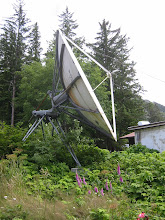
Our satellite footprint in Alaska is in the middle of Spring Sun Outages through March 4. ARCS satellite dish antennas around Alaska aimed at SES Americom's AMC-8 spacecraft (aka: Aurora III) are experiencing brief outages between 12:15 and 12:40 P.M. daily.
All services inside our multiplex on transponder 18 are affected, including ARCS, Alaska One, UATV, and the associated audio channels. Also affected are the SCPC radio channels on transponder 24.
These twice-yearly outages occur when the sun and the satellite we look at are aligned for a few minutes each day over the course of two weeks. They are not caused by sun spots.
Thursday, February 25, 2010

Wednesday, February 3, 2010
February 2010 Required Monthly Test
ARCS TV successfully received and retransmitted the test of Alaska's EAS on Wednesday, February 3, 2010 at 0758 AST. The test in this recording was viewed at the APBI offices in Anchorage using a 3.0 meter Cband dish and a Scientific Atlanta D9223 receiver. The ARCS program service is part of a multiplex which includes several other video and audio sources. In the video you can see ARCS is in the upper left corner of the multi-monitor, and a second feed of ARCS from a separate receiver in the lower center position.
In the upper right is the statewide Alaska One PBS feed. In the lower left position is the closed circuit UATV channel from the University of Alaska. On the lower right, and on the separate monitor, is the local GCI cable service.
In the upper right is the statewide Alaska One PBS feed. In the lower left position is the closed circuit UATV channel from the University of Alaska. On the lower right, and on the separate monitor, is the local GCI cable service.
Wednesday, January 6, 2010
ARCS TV Successfully Participated in the Alaska EAN Exercise
ARCS Television, in cooperation with the Department of Homeland Security’s Federal Emergency Management Agency (FEMA), the Federal Communications Commission (FCC), the State of Alaska, and the Alaska Broadcasters’ Association, participated in the statewide exercise of the Emergency Alert System (EAS) in Alaska on Wednesday, January 6, 2010, at 10:00 A.M. AST. ARCS successfully received the simulated Emergency Action Notification and relayed it via satellite across Alaska to ARCS viewers in over 200 communities, as well as to radio and television broadcast stations and cable television systems across the state.


The ARCS system is monitored, maintained, managed and operated by Alaska Public Broadcasting, Inc., from it's headquarters in Anchorage where a FEMA observer joined the ARCS team as they monitored their part in the exercise. This first video was recorded on a Canon PowerShot A540 camera stationed in front of the main ARCS multi-monitor display. In the video you can see the ARCS channel at the top left, as well as bottom center, using two separate and different models of satellite receivers for confidence. In the video you can hear the exercise being carried out via the conference call on speaker phone in the background, as well as the audio over ARCS in the foreground.
At the time of the test, ARCS was carrying the local CBS affiliate, KTVA. just before the initial header burst is heard, you can see a slide proclaiming "this is a test" put up by KTVA. A few seconds later, the "Chill, It's Just A Drill" slide provided by the Alaska Broadcasters Association and designated by the State of Alaska's Emergency Preparedness Office, was invoked by remote control of the ARCS video switcher. You can see this slide was also used by the statewide Public Television channel, Alaska One, in the upper right hand corner of the display. In the lower right hand corner is a feed from GCI Cable TV, and at lower left the University of Alaska Television channel (UATV). The time displayed at center screen is accurate to within one second.
At the time of the test, ARCS was carrying the local CBS affiliate, KTVA. just before the initial header burst is heard, you can see a slide proclaiming "this is a test" put up by KTVA. A few seconds later, the "Chill, It's Just A Drill" slide provided by the Alaska Broadcasters Association and designated by the State of Alaska's Emergency Preparedness Office, was invoked by remote control of the ARCS video switcher. You can see this slide was also used by the statewide Public Television channel, Alaska One, in the upper right hand corner of the display. In the lower right hand corner is a feed from GCI Cable TV, and at lower left the University of Alaska Television channel (UATV). The time displayed at center screen is accurate to within one second.
At the end of the test, you can hear the End Of Message (EOM) bursts indicating the end of the exercise on ARCS. As our system returned to regular programming you can see that the switcher was instructed manually (in error) to go to Alaska One for a couple of seconds before being further switched (correctly) back to KTVA. Even though the exercise had run its course and was completed at this time, you can see and hear some of the video and audio still present on KTVA.
You may be able to see in the crawl at upper right that the time listed for the event is 11:02 to 11:17. This should have read 10:02 to 10:17 and was the result of a an incorrect UTC offset inside the Sage ENDEC at the ARCS uplink suite. That error has now been corrected.
Below are images of the two printouts from the ARCS ENDEC boxes. First is the tape from the unit at the ARCS switcher showing that it did indeed receive the message from KFQD and successfully relayed the message. You can also see that the time error is evident on this tape. Second is the tape from the monitoring station at APBI's office in Anchorage. Notice that the time on this tape is correct, demonstrating that the UTC offset was correctly set on this unit.


This second video was recorded on a separate receiver tuned only to ARCS and fed into a VHS recorder. It was later converted into digital format for presentation here. This is what the ARCS viewers in communities around rural Alaska would have seen.
In summary, the ARCS and APBI staff are happy to have been able to participate successfully in this exercise and would like to thank all those involved.
In summary, the ARCS and APBI staff are happy to have been able to participate successfully in this exercise and would like to thank all those involved.
Tuesday, November 3, 2009
November Required Monthly Test
Another successful test of Alaska's EAS on ARCS was carried out on Monday, November 2, 2009 at 1531 AST. The test in this recording was viewed at the APBI offices in Anchorage using a 3.0 meter Cband dish and a Scientific Atlanta D9223 receiver. The ARCS program service is part of a multiplex which includes several other video and audio sources. In the video you can see ARCS is in the upper left corner of the multi-monitor. Watch the colors as they fly through the air.
In the background audio you can hear a second set of tones and data bursts. That is coming from the Sage ENDEC at the other end of the room as it responded to the test.
In the background audio you can hear a second set of tones and data bursts. That is coming from the Sage ENDEC at the other end of the room as it responded to the test.
Subscribe to:
Posts (Atom)


 Posts