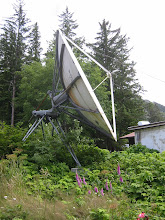
Consumers of television and television-like programming have more options today for delivery of content than ever before. Amid all the chaos and confusion that accompany emerging marketplaces and overlapping technologies I have seen it frequently stated that over the air television (OTA) is a dead or dying medium. I am not an expert on the subject and I won't try to completely voice my disagreement with these statements, but I will point out two items that inform my opinion.
First, the sheer bandwidth capacity of OTA television is impressive, more so when compared to typical consumer bandwidth plans both mobile and landline. For comparison, a mobile user on AT&T's network can get 2 GB of throughput per month for $30. A cable television modem might bring 100 GB of throughput for $100 per month. At first these seem like insurmountable usage limits, but consider the proliferation of services and providers who increasingly invite their consumers to stream video and audio on these networks. A single user at home might not exceed their limits, but multiple users such as a family surely will test them. I know this from personal experience and the overage charges can be quite shocking, if not downright painful.
A single channel of OTA digital television delivers 6 terabytes per month. From my house I can receive six such stations. That's about 36,800 GB of throughput. And I live in a relatively small market for television. And I don't directly pay for that data.
I know, it's not an apples-to-apples comparison. Still, it is impressive.
The second item I want to point out is the recent agreements reached between the NFL and broadcast television networks. The headline reads, "CBS, FOX & NBC Sunday packages extended through 2022 season – longest-ever NFL agreements with over-air broadcast partners" Here's the link.
The point is this: People who are much smarter than I are investing an incredible amount of resources in the future of broadcast television.
Almost everything about television, from the way it is created and produced, marketed and distributed, to its eventual delivery to consumers, and certainly the many ways in which it is consumed, have changed and will continue to change. But whatever happens in the commons, my money is on the broadcast networks remaining firmly ensconced at the top. And for viewers of the ARCS Television Network, that's a good thing.
Thursday, January 19, 2012

Friday, February 18, 2011
ARCS Satellite To Make Its Biannual Solar Transit
As we approach the vernal equinox, consumers of satellite communications services are mindful of the brief outages we experience when the satellite at which we peer briefly crosses paths with the sun.
You can calculate more exact times and dates at this web page.
Public Radio stations with NPR satellite dishes can find out more about their solar transit outage schedule at this link.
For AMC8, (aka Aurora III) the satellite serving Alaska at 139°W, expect outages to begin as early as February 23rd, and last until as late as March 5th. Outages will occur between noon and 1:00 PM and will last from 5 to 15 minutes. The ARCS multiplex on transponder 18 and all associated services will be affected by these outages, including:
ARCS TV
Alaska One TV
University of Alaska TV
APRN
KSKA
KUAC
KCAW
KUCB
Any other audio services
Also affected will be the SCPC satellite radio services on transponder 24, including:
APRN
KNBA
KMXT
Public Radio stations with NPR satellite dishes can find out more about their solar transit outage schedule at this link.
Thursday, February 3, 2011
February 2011 RMT
ARCS Television successfully received and relayed the RMT at 0752.
Audio, though intelligible, was distorted and partially obscured by static. It was not the correct audio for this test, a problem that has been traced to the equipment at the site responsible for generating this month's test. Information in the video crawl generated by the ARCS equipment was correct as to time and type of test. EOM tones from the originator were delayed, causing some decoders to timeout, as shown on the tape from APBI's confidence decoder. The ARCS decoder at the uplink did not abort and stayed connected until EOM tones were relayed (they are heard at the end of video).

Thursday, January 27, 2011
ARCS Successfully Partipated in the 2011 Alaska EAN Live Code Test
On Wednesday, January 26, 2011, at 10:00AM Alaska time, the ARCS Television Network successfully received and relayed the EAS test consisting of the live EAN code and extended test message. Following is a recording of the test as seen from an ARCS satellite receiver at our downlink monitoring rack, along with an image showing the printout from a Sage ENDEC connected to the same ARCS satellite receiver for demonstration and confidence purposes.
As the video begins you see the top of hour ID from Alaska One, then the scheduled switch at 10:00 to KTVA where they are in a furniture commercial. A few seconds later the test begins. The header tone audio is muted for this recording. You can see the ARCS crawl, then the KTVA test slide, then the ARCS slide for the duration. Inside the crawl, you can see the time is off by one hour due to an error in the GMT offset inside the ARCS ENDEC. This did not affect any downstream system; it only affected the time displayed in the ARCS crawl. Audio from the test message begins 50 seconds later, it is clear and easy to understand. At the end of the test the EOM is heard and the system returns to normal programming.
Here is an image of the tape printed by the Sage ENDEC at the APBI offices. This represents how any decoder listening to ARCS would have performed. You can see from the time on the tape that this unit was not affected by the ARCS ENDEC offset error mentioned above.

ARCS plays a central role in the State of Alaska Emergency Relay Network as a conduit to commercial and noncommercial radio and television broadcasters. As provided for in the State’s Emergency Alert System Plan the ARCS satellite signal is a designated monitoring choice and is available to all Alaska broadcasters for their use in EAS participation.
Subscribe to:
Posts (Atom)


 Posts